
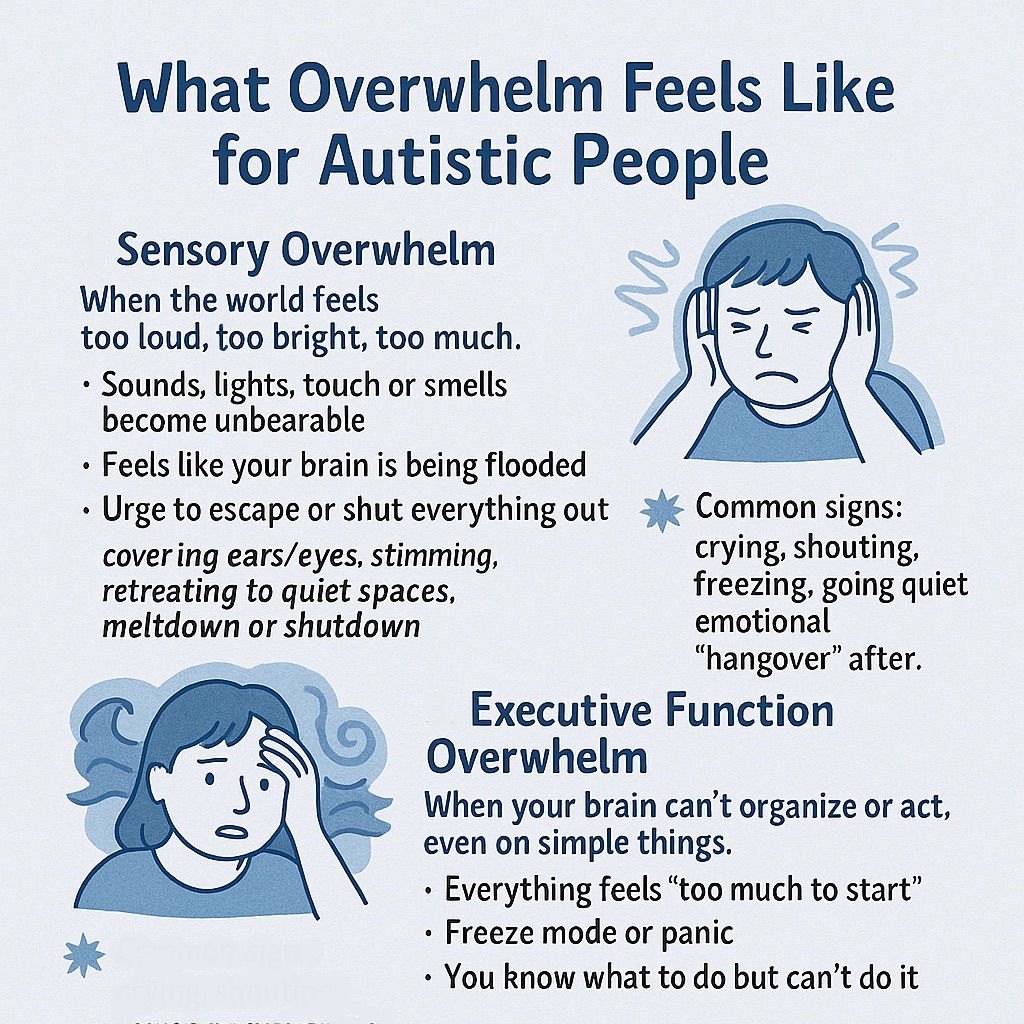
Overwhelm in autistic people can be especially intense — and it often comes from multiple layers happening at the same time: sensory input, emotions, social dynamics, and executive function demands.
Here’s how it often shows up in three overlapping types 👇
🌀 1. Sensory Overwhelm
This happens when the brain receives more sensory input than it can comfortably process.
What it can feel like:
Every sound feels too loud and blends together — conversations, ticking clocks, traffic. Lights feel too bright or flickery. Clothes, textures, or smells feel unbearable. A rising inner pressure — like your nervous system is “short-circuiting.” You might feel trapped in your own body, desperate to make it all stop.
Typical reactions:
Covering ears or eyes, Rocking, stimming, retreating to a quiet place, Meltdown or shutdown if relief isn’t possible
👉 Common triggers: crowded places, overlapping noise, fluorescent lighting, unexpected touch.
🌊 2. Emotional Overwhelm
This is when strong feelings — fear, frustration, joy, anger, sadness — become too intense to regulate.
What it can feel like:
Emotions arrive all at once with no clear “why.” Words disappear, and it’s hard to express what’s happening inside. A tidal wave feeling: “too much, too fast.” Physical sensations (racing heart, tight chest) amplify the distress.
Typical reactions:
Meltdown (crying, shouting, or explosive release) Shutdown (quiet withdrawal, stillness, non-responsiveness) Emotional hangover afterward — feeling drained, foggy, or ashamed
👉 Common triggers: rejection, feeling misunderstood, sudden changes, criticism, sensory stress piling up.
🧭 3. Executive Function Overwhelm
This happens when the brain struggles to organise, plan, or handle multiple demands.
What it can feel like:
Even simple tasks feel impossible — like hitting a wall. Brain fog, paralysis, or “freeze mode.” A sense of panic because you know what to do but can’t do it. Guilt or frustration builds, worsening the overwhelm.
Typical reactions:
Avoidance or procrastination (not out of laziness, but overload) Emotional outburst or shutdown Needing clear steps or external support to restart
👉 Common triggers: too many decisions at once, sudden time pressure, multi-step tasks, unexpected changes.
🌿 How It Can Look From the Outside
Going nonverbal or struggling to speak Becoming very still or very agitated Retreating to a safe or quiet space Seeming “rude” or “shut down” (when it’s really self-protection) Stimming increasing (hand flapping, rocking, pacing, fidgeting)
🫧 After Overwhelm — “Recovery Mode”
Many autistic people experience what’s sometimes called a “crash”:
Exhaustion, brain fog, and sensitivity Needing quiet time or solitude Difficulty explaining what just happened A strong need for comfort, routine, or calming sensory input
✅ Helpful supports during overwhelm:
A safe, quiet, low-sensory space Gentle, predictable language (or no language at all) Allowing stimming or self-soothing behaviours Not forcing eye contact or conversation Weighted blankets, noise-cancelling headphones, soft textures, familiar routines
If you have any helpful suggestions, please leave a comment below.

Leave a comment