
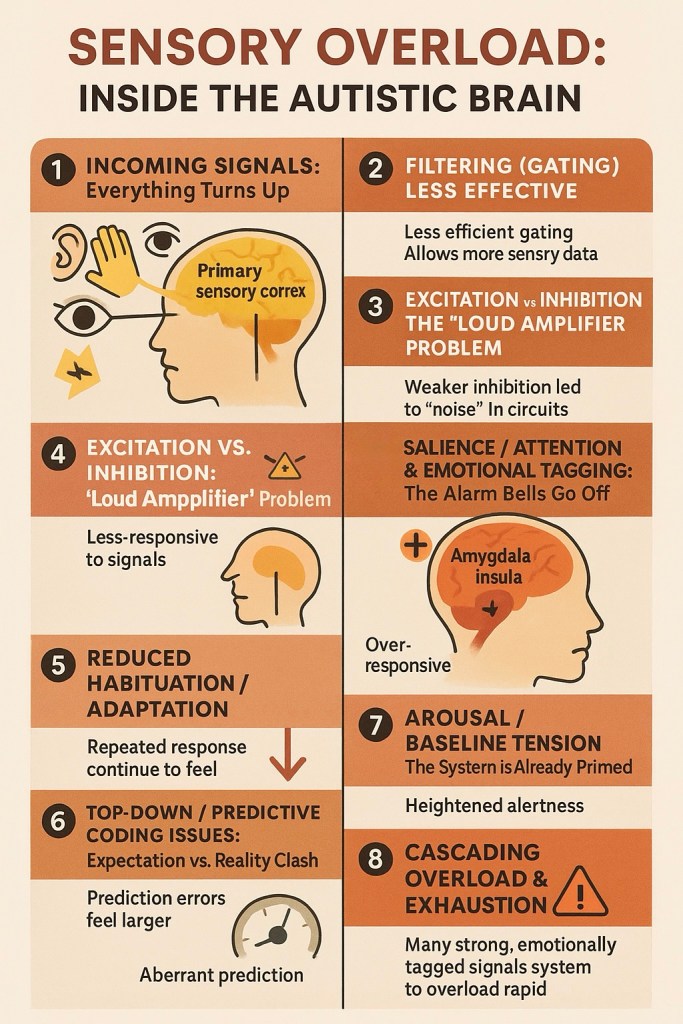
1) Salience & emotion circuits go “too loud,” and they don’t settle
fMRI studies show hyper-responsivity to everyday sights/sounds/touch in primary sensory cortices and in the amygdala/anterior insula (key hubs of the salience network). Importantly, autistic participants with higher SOR show reduced neural habituation—their responses don’t “calm down” with repetition as much as non-autistic controls.
2) Thalamocortical “gating” is atypical
The thalamus helps regulate (gate) sensory input to cortex. Large-sample resting-state MRI finds thalamocortical hyperconnectivity with sensorimotor, temporal, and prefrontal regions in autism, and newer work links this circuitry directly to SOR measures. This can mean more raw input reaches cortex and is harder to filter.
3) Excitation–inhibition (E/I) balance is shifted in sensory cortex
Magnetic resonance spectroscopy repeatedly reports lower GABA (the brain’s main inhibitory neurotransmitter) in autistic groups, especially in sensorimotor/tactile areas, and lower GABA relates to worse tactile performance or higher SOR. Mechanistically, less inhibition → hyper-excitable sensory circuits.
4) Predictive coding: the brain may over-weight “surprise”
Computational accounts suggest autistic perception assigns excess precision to incoming sensory signals (or too little to priors), so prediction errors feel larger and more frequent. In busy environments that means continual “mismatch” signals, experienced as overload. Empirical work shows atypical multisensory predictive coding that fits this picture.
5) Arousal systems (locus coeruleus–noradrenaline) are cranked up
Pupillometry (a window into locus-coeruleus activity) finds elevated tonic arousal and altered phasic responses in autistic children, and links to attention control—consistent with an over-aroused baseline that makes sensory input feel intense and harder to down-regulate.
Salience & Emotional Tagging: what’s happening neurologically 🧠
When sensory information reaches the amygdala and anterior insula, these regions act as “relevance detectors” — deciding what the brain should pay attention to and what might be a threat or urgent.
👉 In autistic people during sensory overload:
Amygdala activity is heightened, tagging even neutral sensations as “important” or “potentially threatening.” Anterior insula overactivation increases the feeling of “intensity” or “urgency.” This salience signal amplifies the experience, making ordinary input feel overwhelming. Unlike neurotypical brains, autistic brains often show less downregulation after the first spike of activation, meaning the intensity lingers rather than fading.
🧠 Result: the system is flooded not just with stronger sensory input but with stronger emotional weight attached to it.
This is why seemingly “small” stimuli (like a buzzing light or tapping sound) can feel unbearable—because the brain’s alarm bells are louder and stay on longer.
Putting it together (plain-language)
During overload, incoming sights/sounds/touch are amplified by hyper-excitable sensory cortex (E/I shift), flagged as urgent by the amygdala/insula and thalamus (salience + gating), don’t habituate as quickly, and land on a system with higher baseline arousal; meanwhile the brain’s predictive filters treat differences between expectation and reality as bigger than usual. The combined effect is a rapid climb in intensity and stress that’s hard to damp down.
Representative, accessible sources
Green et al. (UCLA): SOR linked to amygdala/insula responsivity and reduced habituation; salience-network connectivity tracks SOR severity.
Woodward et al. / Wagner et al.: Thalamocortical hyperconnectivity and direct SOR–thalamus associations.
Puts et al.; Mikkelsen et al.; Wood et al.: Lower GABA in sensorimotor cortex tied to tactile performance and SOR.
Lawson et al.; Pellicano & Burr reviews; van Laarhoven et al.: Predictive-coding/aberrant-precision accounts with multisensory evidence.
Kim et al.; Zhao et al.: Pupil-linked arousal (LC-NE) differences in ASD.

Leave a comment