
Health Conditions Linked with Autism Spectrum Disorder (ASD)
Autism is often described in terms of social communication, sensory differences, and unique ways of processing the world. But for many autistic people, autism also comes alongside other health conditions. Some of these overlaps are well established in research, while others are emerging areas of study.
Recognising these links is important for healthcare, early support, and understanding the whole autistic person.
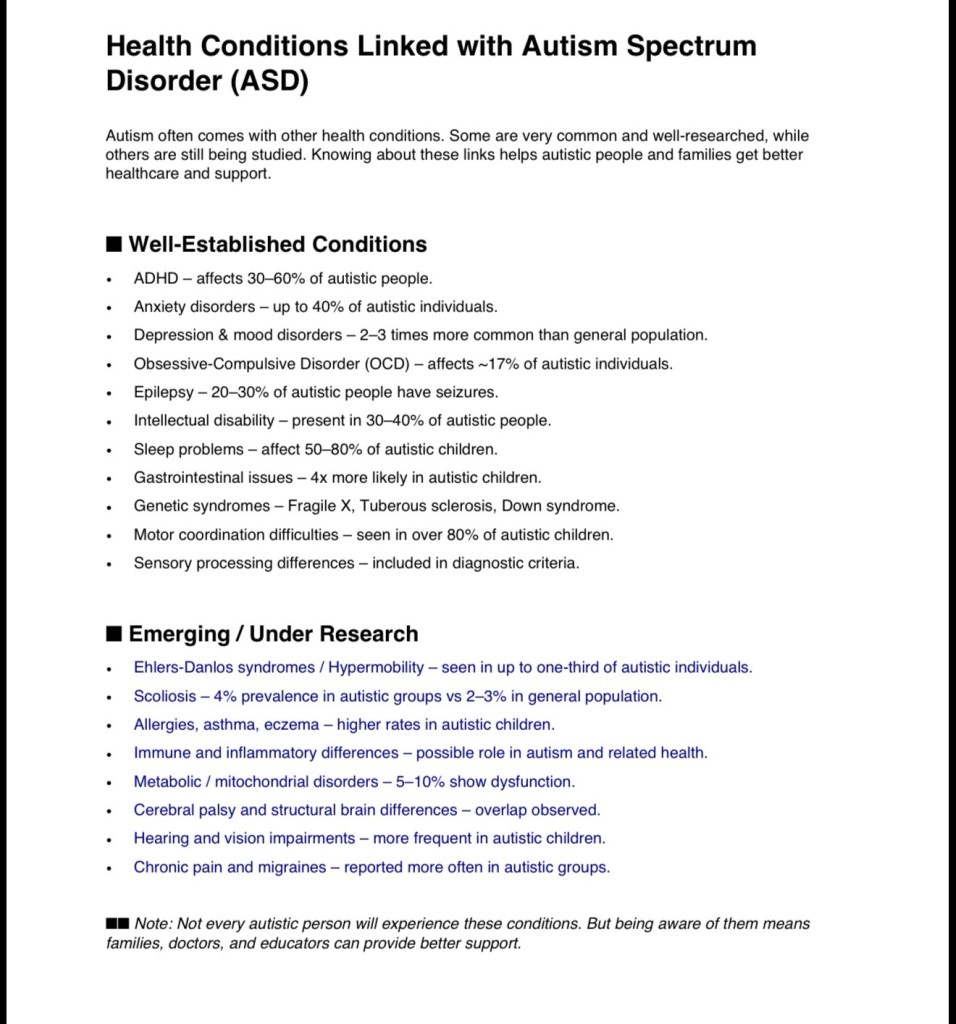
Well-Established Comorbidities
These conditions are consistently found at higher rates in autistic populations:
ADHD – Between 50-80% of autistic people also meet criteria for ADHD (Leitner, 2014).
Anxiety disorders – Up to 40% of autistic children and adults have clinical anxiety (van Steensel et al., 2011).
Depression and mood disorders – Rates of depression are two to three times higher in autistic adults (Hudson et al., 2019).
Obsessive-Compulsive Disorder (OCD) – Around 17% of autistic individuals meet criteria for OCD (Russell et al., 2005).
Epilepsy – Seizure disorders affect 20–30% of autistic people (Besag, 2018).
Intellectual disability – Around 30–40% of autistic individuals also have intellectual disability (Baio et al., 2018).
Sleep disorders – Between 50–80% of autistic children experience chronic sleep problems (Couturier et al., 2005).
Gastrointestinal issues – Autistic children are about four times more likely to experience GI symptoms (McElhanon et al., 2014).
Genetic syndromes – Fragile X syndrome, Tuberous sclerosis, and Down syndrome all have strong overlaps with autism. For example, one-third of people with Fragile X also meet autism criteria (Hagerman et al., 2017).
Motor coordination difficulties – Over 80% of autistic children show motor delay or dyspraxia (Fournier et al., 2010).
Sensory differences – So common they are now included in diagnostic criteria (APA DSM-5, 2013).
Emerging and Under Research
Other conditions are increasingly recognised in autistic populations, though evidence is still developing:
Ehlers-Danlos syndromes (EDS) and hypermobility – A 2025 meta-analysis found that ~25–40% of autistic individuals show joint hypermobility or related conditions (Casado-Morales et al., 2025).
Scoliosis – In one cohort of over 8,000 autistic children, 4.2% had scoliosis compared with 2–3% in the general population (Wu et al., 2023).
Allergies, asthma, eczema – Autistic children show higher rates of allergic and immune-related conditions (Zerbo et al., 2015).
Immune and inflammatory differences – Research into neuroinflammation and immune system activity in autism is ongoing (Goines & Van de Water, 2010).
Metabolic / mitochondrial disorders – Around 5–10% of autistic individuals show signs of mitochondrial dysfunction (Rossignol & Frye, 2012).
Cerebral palsy and structural brain differences – Autism is more common in children with cerebral palsy, suggesting overlapping developmental pathways (Christensen et al., 2014).
Hearing and vision impairments – Higher prevalence of hearing loss and vision problems has been documented in autistic groups (Jain et al., 2020).
Chronic pain and migraines – Surveys suggest higher self-reported pain and migraine frequency, possibly linked to sensory differences and hypermobility (Baeza-Velasco et al., 2018).
Why This Matters
Autism is not a single, isolated condition. It often exists alongside other medical, neurological, and physical health issues. Understanding these overlaps:
Helps doctors provide more accurate diagnoses. Guides families to seek the right supports. Improves quality of life for autistic people by addressing the whole person, not just the autism label.
References (selected)
Baio J et al. (2018). Prevalence of Autism Spectrum Disorder Among Children Aged 8 Years. MMWR.
Besag FMC. (2018). Epilepsy in patients with autism: links, risks and treatment. Neuropsychiatry.
Casado-Morales MI et al. (2025). Joint hypermobility, hypermobility spectrum disorders, and Ehlers-Danlos syndromes in autism: A systematic review and meta-analysis. PubMed.
Couturier JL et al. (2005). Prevalence and risk factors for sleep problems in a community sample of children with autism spectrum disorder. J Autism Dev Disord.
Fournier KA et al. (2010). Motor coordination in autism spectrum disorders: a synthesis and meta-analysis. J Autism Dev Disord.
Goines P, Van de Water J. (2010). The immune system’s role in the biology of autism. Curr Opin Neurol.
Hagerman RJ et al. (2017). Fragile X syndrome and autism spectrum disorder.
Am J Med Genet. Hudson CC et al. (2019). Depression in adults with autism spectrum disorder: a systematic review. J Autism Dev Disord.
Jain A et al. (2020). Sensory impairments in autism spectrum disorder. Autism Res.
McElhanon BO et al. (2014). Gastrointestinal symptoms in autism spectrum disorder: a meta-analysis. Pediatrics.
Rossignol DA, Frye RE. (2012). Mitochondrial dysfunction in autism spectrum disorders. Mol Psychiatry.
Russell AJ et al. (2005). Obsessive compulsive disorder in autism spectrum disorders and intellectual disability. Autism.
van Steensel FJ et al. (2011). Anxiety disorders in children and adolescents with autism spectrum disorders: a meta-analysis. Clin Child Fam Psychol
Rev. Wu S et al. (2023). An Analysis of Scoliosis in Autism Spectrum Disorder. Pediatric Academic Societies Meeting.
Zerbo O et al. (2015). Immune conditions in autism spectrum disorder: a systematic review and meta-analysis. Pediatrics.

Leave a comment